After exploring the tamami mat rocks and Hodosan Shrine, it was time to head up the mountain. The kids were eager to get started, but we paused to fill them with food and take a quick bathroom break before hitting the trail. I learned a long time ago that it is always so important to fill up your kid before hiking, otherwise it can be a very whiny adventure!
The trail is a gentle, but steady climb up the 497.1 m / 1,631 ft mountain. This is a trail for all seasons, as the path is wide and well maintained. There were lots of people hiking on this beautiful Saturday, but it never seemed crowded. I still can't get over how many people we see when we are hiking in Japan, but maybe we just aren't going rural enough.
We stopped a couple times just to relish in the view, as it was super pretty.
I wanted to go on this trail because I wanted to see the wintersweet blooms that can be found at the top. A grove of wintersweet trees, also known as robai or yellow wax plums, is right at the summit. Now, I know you can take a ropeway straight to the top to see the blooms, but hiking up only took about an hour (it's much faster without little legs) and is a worthwhile stroll.
The blooms live up to their name by releasing a sweet scent into the cold air. It was lovely at first, but got a bit strong as we walked through the trees.
When my husband had seen enough of the yellow topped trees, he wandered over to the shrine at the top of the mountain. It is part of Hodosan Shrine at the base of the hill. The one on top is not colorful or adorned with carvings like the other one is, but it still feels like a special place.
After we were all done enjoying the flowers and shrine, we headed down the ropeway. While I am not a big fan of being high in the sky, I wasn't bothered by the height of this particular gondola. Maybe it was because I was in the middle of the car, I don't know. But I enjoyed watching the town get closer and closer.
Beyond the benefits of being in nature and enjoying the views of everything from small blossoms to calming scenery, the best part of hiking Mount Hodo was spending time with my family. Nagatoro was a lovely little town with lots of beautiful nature. I'd love to go back in other seasons, as the town is well know for several types of blooming trees.
In 2017 my family headed to Tokyo. My husband had a new job and my son and I came along for the ride. This move was my second move to Japan - the first was for a year in 2002. At that time I was a single, recent college graduate. Moving abroad as a family was a whole different ball of wax. As I live this crazy life in Japan, I track our adventures and my observations, creating an unofficial guidebook to the city.
Showing posts with label Hiking. Show all posts
Tuesday, February 4, 2020
Sunday, February 2, 2020
Exploring Nagatoro (Part 2 of 3)
After looking, touching, and appreciating the tatami mat rocks for an hour, it was time to head back to the train station to pick up some more Hike it Baby families. We could have stayed longer as it was very fascinating, but we needed to continue on.
When the whole group was gathered, we consisted of 6 adults and 6 kids. There were both familiar and new faces, which is always so nice. The kiddos ranged in age from 2 to 9.
As a group, we walked up to Hodosan Jinja, a shrine within a 10 minute walk of Nagatoro station. It is a beautiful shrine known for the colorful sculptures carved into the main building.
Built in 110 A.D., the shrine is said to have been constructed by a Prince after surviving a fire on the mountain. In the story, the Prince and his army try to fight the fire, but end up being saved by a pack of dogs that are spirits and then led to the top of the mountain. After this experience the Prince built the shrine and enshrined three God - Kamu-yamato-iware-biko-no-Mikoto (Emperor Jimmu, who founded Japan), O-yama-tsumi-no-Kami (Mountain Deity), and Ho-musu-bi-no-Kami (Fire Deity).
Today over a million people go to the shrine to pray for their family's safety, prosperity in business, protection from fire and robbery, traffic safety, and good fortune with money, among other things, every year.
Although the main shrine is super beautiful, it isn't the only thing to see. There are actually several other shrines on the premises to view and ask for guidance on a whole variety of topics. The group separated and came back together as we explored the shrine.
It was a great place to start our adventure together.
To be continued...
When the whole group was gathered, we consisted of 6 adults and 6 kids. There were both familiar and new faces, which is always so nice. The kiddos ranged in age from 2 to 9.
As a group, we walked up to Hodosan Jinja, a shrine within a 10 minute walk of Nagatoro station. It is a beautiful shrine known for the colorful sculptures carved into the main building.
Built in 110 A.D., the shrine is said to have been constructed by a Prince after surviving a fire on the mountain. In the story, the Prince and his army try to fight the fire, but end up being saved by a pack of dogs that are spirits and then led to the top of the mountain. After this experience the Prince built the shrine and enshrined three God - Kamu-yamato-iware-biko-no-Mikoto (Emperor Jimmu, who founded Japan), O-yama-tsumi-no-Kami (Mountain Deity), and Ho-musu-bi-no-Kami (Fire Deity).
Today over a million people go to the shrine to pray for their family's safety, prosperity in business, protection from fire and robbery, traffic safety, and good fortune with money, among other things, every year.
Although the main shrine is super beautiful, it isn't the only thing to see. There are actually several other shrines on the premises to view and ask for guidance on a whole variety of topics. The group separated and came back together as we explored the shrine.
It was a great place to start our adventure together.
To be continued...
Saturday, February 1, 2020
Exploring Nagatoro (Part 1 of 3)
We spent the day in Nagatoro hiking with Hike it Baby. It was another amazing day that has left us tired, happy, and grateful for such an amazing experience of exploring with our son.
My husband joined us for this adventure that started with a 2 hour train ride into Saitama.
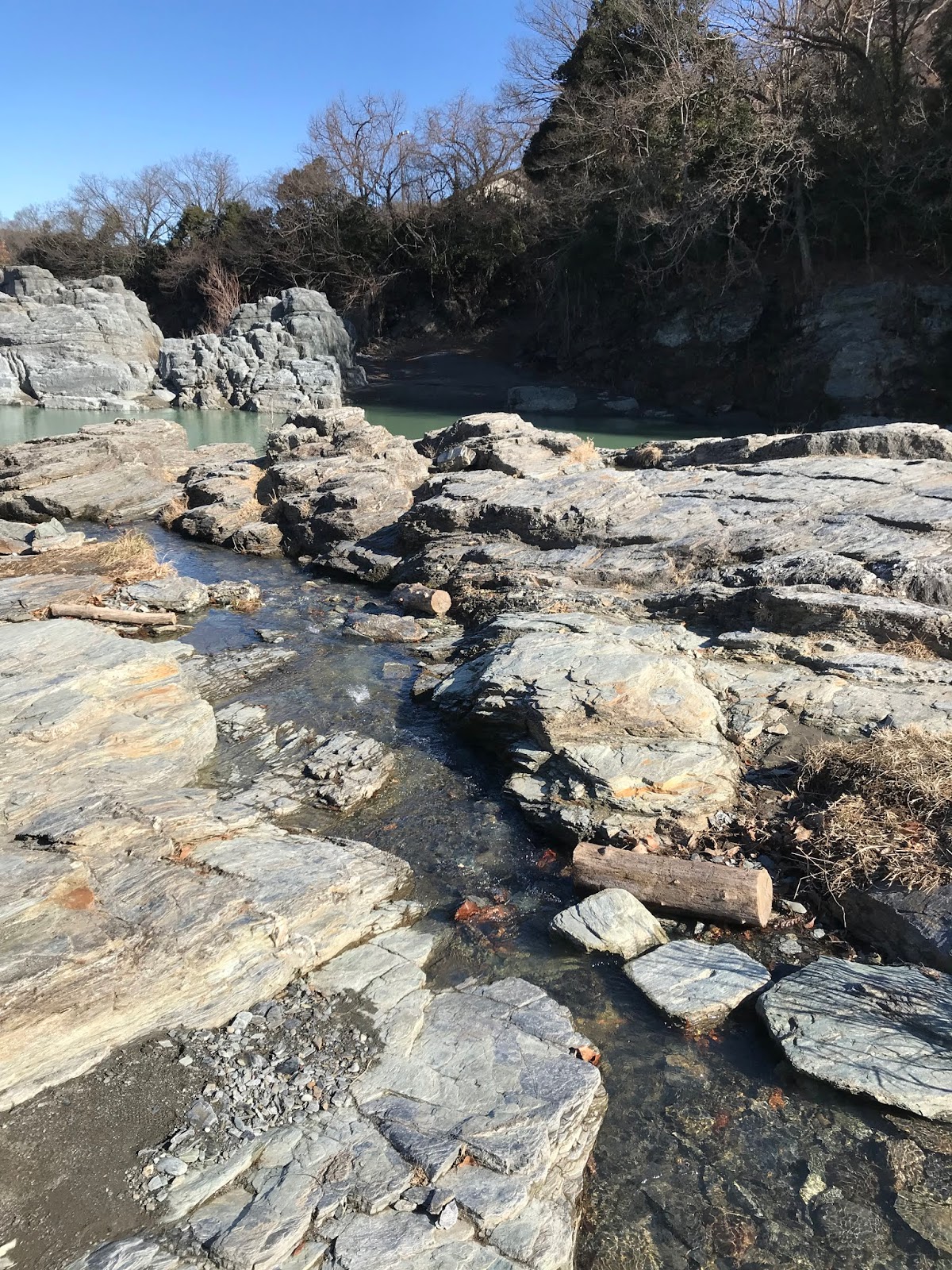
After arriving at Nagatoro Station, we walked with friends just 5 minutes to see the tatami rocks near Arakawa River. Iwadatami (tatami mats of rocks) are thin layers of rocks created naturally by changes in the earth's crust and erosion from the river. No matter the explanation of their creation, they are beautiful and interesting to see.
My son loves climbing, so this was the perfect place to play. (We kept a close eye on him to make sure he was staying safe.) He quickly transformed into a lion seeking for his place on Pride Rock. I love how a little bit of time out in nature brings out his creative side.
We stayed for about an hour, but we all could have stayed for longer. My son liked digging in the sand. I liked watching the tour boats go down the river. My husband liked exploring the naturally occurring pot holes. And we all enjoyed walking and exploring the neat rocks.
To be continued...
Sunday, January 12, 2020
Not just any hike (Part 2)
Continued from previous post...
The trail is comprised mainly of stairs made from wood, tree roots, and rocks. 95% of it is incline via stairs of varied heights and widths, with small sections of leveled out paths here and there.
Every person on the trail said “konnichiwa” to us. A few stopped to compliment my son or encourage him. There were lots of people heading up along with us, but it didn’t feel crowded by any means.
Although I tried not to focus on others, I did notice and reflect upon the couple people I saw on the trail without shoes. I imagine they were hiking shoeless in order to be more connected to the mountain, and therefore the god within the mountain. I admired this story I made up and even felt a bit envious of it.
There were a few times that I really wanted to take a photo. The forest was beautiful. My son asked me to take a couple photos of fallen trees and a small waterfall. But I resisted. I explained to him about how some things are not meant to be photographed, especially religious things, and it was important for us to take a mental picture and remember it with our minds and our hearts. In the end, I’m glad photography isn’t allowed, as it would detract from the experience.
There are 9 markers on the trail. Our goal (even though we shouldn’t have had one) was to reach the third marker. But after arriving there, we felt like we could continue. Up, up, up we went. Stopping to let people pass and to really take in our surroundings. After an hour and a half, we had walked the about 2 kilometers/1.25 miles up the mountain. It was a 387.1 meter/1,270 foot climb (we started at an elevation of 80 meters and summited at 467.1 meters), which my husband’s phone reported as 99 flights of stairs. Regardless of the distance or the incline, we made it to the shrine building and the iwakura (place where the deity resides) at the top of the mountain.
I have always experienced a profound feeling of peace within the grounds of Miwa Jinja. But walking up the path brought a whole new level of serenity. While I was out of breath for parts of the stair climb, I never wanted to stop. I felt supported in my ascent.
I expected to see an amazing view, but was instead greeted by a stunning sight of rocks, trees, and Shinto ropes. There wasn’t a place to see the horizon or even down the mountain. It was, in fact, the place where it is said the deity, Ohmononushi-kushimikatama-no-Mikita, descended to the earth. It truly was a spiritual journey.
After going back down the mountain, we all exclaimed what an amazing gift it was to be able to go up Mount Miwa. It is something that we will hold in our hearts for a very, very long time.
Saturday, January 11, 2020
Not just any hike (Part 1)
My family decided that we needed to take a quick trip to Nara Prefecture to visit our beloved Miwa Jinja. The main reason for our trip is to buy a new Ofuda (a religious amulet) and return the old one. We buy a new one every year and it is best done at the beginning of each year. We also wanted to go because we find this shrine to be incredibly rejuvenating and energizing. While we would have preferred to go to Miwa last weekend, right after the start of the new year, my husband found out that we could do something incredibly special by delaying our trip for a week.
He has always known that people can climb Mount Miwa, home of Ohmononnushi-no-ohkami, the main deity of Miwa Jinja. It is open most of the time, but not the first three days of each year or during the major shrine festivals because it would attract too many people. After weighing our options, we decided we really wanted to climb Mount Miwa and waited an extra week before going.
We got up early in our Airbnb near JR Nara Station and boarded the train to Miwa at 8 am. It takes just over a half hour to travel from Nara to Miwa. We wanted to be at the trailhead when it opens to the public at 9 am. The entrance is tucked back next to Sai Jinja, the shrine building that holds the deity for good health.
Everyone who climbs has to register. My husband paid the ¥300/$3 fee for each person as well as filled out a form that gave our name, address, and phone number. First time climbers must listen to a short lecture. It was at this time we were told that going up the mountain is not a hike. It is a form of worship and religious training. The purpose of the trail isn’t to reach the top, it is to go on a journey. They said it is okay to stop whenever you feel closer to the deity and return from there. There is no judgment for those that don’t walk the entire path. (It wasn’t mentioned at that moment, but on the website it clearly states that foreigners are allowed to climb, but they must do so with someone who can speak Japanese fluently. They must also have a phone that works in Japan, I assume in case they get lost.)
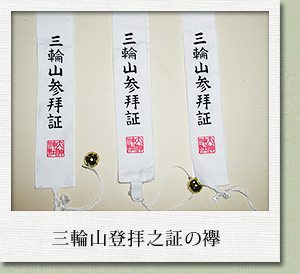
Since it is a religious journey, those that walk the path typically wear white. Since we (and practically everyone else that was there) were not wearing white (and as a way to make sure everyone that registered actually returned), each person was given a wide white ribbon with a bell on the end. We were told to wear it the entire time.
![]() |
| Photo credit: oomiwa.or.jp |
Because this is a sacred place, meant for contemplation and reflection, they informed us that taking photos was prohibited. I felt a bit disappointed by this, but I understood the reasons for the rule.
We knew the trail would be steep, so we each grabbed a bamboo walking stick that would assist us along the way. There is a big box of them in various sizes right next to the entrance of the trail.
After cleansing ourselves with shrine prayers, waving special sticks adorned with sacred paper over our heads and bowing at the entrance, indicated by the Shinto rope that defines areas of sacred space, we thanked the deity for allowing us to go up the mountain and started our ascent.
To be continued...
Sunday, October 27, 2019
We went up, up, up
A while ago another Hike it Baby mom and I decided to host a hike on a trail. Many of the hikes with the Tokyo branch are at parks - which is great, but sometimes we just want to be out on a trail. I find this yearning so funny since my mom always tried to drag me hiking and I almost never wanted to go. In those years, I didn't feel suffocated by the city and lived in a place with beautiful green landscapes all around me. Although we live right next to a fantastic park, sometimes it just isn't enough. In Japanese they say I need "shinrin yoku" or "forest bathing," a cleansing that only nature can provide. Science has proven that walking through the woods can boost immunity, reduce stress, and improve sleep (among other things).
Eager to hit the hills, my husband, son, and I got up bright and early and headed out. Mount Kinsho was calling our name.
We took a couple trains to reach Tobu Takezawa Station, meeting with our friends on the train heading out of town. When we arrived at the station, we saw several signs warning of a local poisonous snake. Undaunted, we headed to the trailhead.
Just a short 5 minute walk from the station, we found ourselves immersed in the woods. The trail was rather wet from the recent rains, but we trekked on. We walked past a lovely stream. Soon the trail headed up and we left the stream behind.
The hill quickly included stairs. I've been on lots of trails with stairs and these ones were not too intense. It does help that we were hiking with two young kids. One thing I like about hiking with young ones is that they go slow enough that the adults can really enjoy the scenery!
We stopped several times for drinks and snacks as well as several spider sightings. After an hour and a half, we made it to the top. (The map said it should take us 40 minutes, but short legs take longer.) The view was awesome, especially when we realized we could see Tokyo. The boys took turns looking through binoculars at buildings in the distance, mountains, and countless butterflies.
It was a wonderful time breathing the fresh air and hanging out with a friend.
Just a short distance past the summit, is the Ogawa Genki Plaza Community Center. We were super excited to go there, but found ourselves disappointed to find out we missed the planetarium show. But we didn't let it get us down, we continued on our way to Yoshida's Farmhouse and exploring the Ogawa area.
While walking back toward the station, we realized that our train wasn't for another 40 minutes. So, we took our time getting back to the station. Trains only pass through two or three times an hour depending on the time of day. As we walked up to the station, we realized we had three minutes to get onto the platform. But as we hurried down the steps, my husband herded us over to the right side of the stairs. He then mentioned that going up the other side was a mamushi or Japanese pit viper, the poisonous snake all the signs warned us about!!!
With a few shrieks released, we ran to the ticket gate where my husband reported the snake to the rail staff. They got the message and we proceeded onto the platform with moments to spare.
It was a fabulous day. The weather was perfect. The kids had a blast. The adults enjoyed the outing and time together. Plus, everybody got a good dose of shinrin yoku.
Eager to hit the hills, my husband, son, and I got up bright and early and headed out. Mount Kinsho was calling our name.
We took a couple trains to reach Tobu Takezawa Station, meeting with our friends on the train heading out of town. When we arrived at the station, we saw several signs warning of a local poisonous snake. Undaunted, we headed to the trailhead.
Just a short 5 minute walk from the station, we found ourselves immersed in the woods. The trail was rather wet from the recent rains, but we trekked on. We walked past a lovely stream. Soon the trail headed up and we left the stream behind.
The hill quickly included stairs. I've been on lots of trails with stairs and these ones were not too intense. It does help that we were hiking with two young kids. One thing I like about hiking with young ones is that they go slow enough that the adults can really enjoy the scenery!
| Photo credit to my HiB friend! |
| Photo credit to my HiB friend! She takes amazing photos. |
| Photo credit to my HiB friend! |
It was a wonderful time breathing the fresh air and hanging out with a friend.
Just a short distance past the summit, is the Ogawa Genki Plaza Community Center. We were super excited to go there, but found ourselves disappointed to find out we missed the planetarium show. But we didn't let it get us down, we continued on our way to Yoshida's Farmhouse and exploring the Ogawa area.
While walking back toward the station, we realized that our train wasn't for another 40 minutes. So, we took our time getting back to the station. Trains only pass through two or three times an hour depending on the time of day. As we walked up to the station, we realized we had three minutes to get onto the platform. But as we hurried down the steps, my husband herded us over to the right side of the stairs. He then mentioned that going up the other side was a mamushi or Japanese pit viper, the poisonous snake all the signs warned us about!!!
With a few shrieks released, we ran to the ticket gate where my husband reported the snake to the rail staff. They got the message and we proceeded onto the platform with moments to spare.
It was a fabulous day. The weather was perfect. The kids had a blast. The adults enjoyed the outing and time together. Plus, everybody got a good dose of shinrin yoku.
Saturday, August 17, 2019
On top of blueberry hill
We are constantly learning about new places to go in Tokyo. Sometimes the activities epitomize Japanese culture, and other times has more of a global appeal. Several weeks ago, a mom with Hike it Baby inquired if anyone would be interested in picking organic blueberries. Our hands immediately shot up with excitement.
Our family loves to pick blueberries. Even though we have 12 young blueberry bushes at our house in the US, we would still go to a blueberry farm each summer to pick tons of berries. The berries we grew at home, we would eat fresh off the bush. My son loved to keep the bushes clean of any berries he could find. We never got to take any inside because he would eat them all in the yard. With the berries from the farm, I would whip up blueberry jam and we'd freeze lots of them to enjoy all winter long.
In Japan, berries are nail-bitingly expensive. Spending ¥400 ($3.75 USD) or more for a cup of berries means we don't eat copious quantities of them. Even though picking them ourselves also wouldn't be cheap, it included an activity, which made the expense more palatable.
We had to be up and out of the house by 7 am in order to make it over to Yokohama by 9 am. The Yokohama Asahi Blueberry no Mori doesn't open until 10, but to make sure everyone arrived on time for our group reservation, the host asked everyone to arrive by 9:15.
Japanese u-pick consists of u-pick and u-eat as much as you can within an allotted time. Typically you do not take any home with you. It is all about indulgence fresh from the tree, bush, or plant - just like my son preferred back in the US.
We paid ¥4,800 ($45 USD) for the three of us to pick and eat as much as we want for 30 minutes and take home 3 containers of organic blueberries. As soon as we were released into the field, we went to town. The berries were huge and plump. We loved feeling no shame about popping each berry into our mouth.
When I was little, my dad would take us berry picking. He would always joke with the farm employee that they should weigh us and not the buckets. In this case, we didn't have to worry about how much our son was eating.
It was 34°C/93°F, so by the time our 30 minutes were up, we were ready to go. Our bellies were more full of berries than they have been for two years. We had berries to take home. It felt like a successful activity for our family - one that we'd like to repeat again and again.
Our family loves to pick blueberries. Even though we have 12 young blueberry bushes at our house in the US, we would still go to a blueberry farm each summer to pick tons of berries. The berries we grew at home, we would eat fresh off the bush. My son loved to keep the bushes clean of any berries he could find. We never got to take any inside because he would eat them all in the yard. With the berries from the farm, I would whip up blueberry jam and we'd freeze lots of them to enjoy all winter long.
In Japan, berries are nail-bitingly expensive. Spending ¥400 ($3.75 USD) or more for a cup of berries means we don't eat copious quantities of them. Even though picking them ourselves also wouldn't be cheap, it included an activity, which made the expense more palatable.
We had to be up and out of the house by 7 am in order to make it over to Yokohama by 9 am. The Yokohama Asahi Blueberry no Mori doesn't open until 10, but to make sure everyone arrived on time for our group reservation, the host asked everyone to arrive by 9:15.
Japanese u-pick consists of u-pick and u-eat as much as you can within an allotted time. Typically you do not take any home with you. It is all about indulgence fresh from the tree, bush, or plant - just like my son preferred back in the US.
We paid ¥4,800 ($45 USD) for the three of us to pick and eat as much as we want for 30 minutes and take home 3 containers of organic blueberries. As soon as we were released into the field, we went to town. The berries were huge and plump. We loved feeling no shame about popping each berry into our mouth.
When I was little, my dad would take us berry picking. He would always joke with the farm employee that they should weigh us and not the buckets. In this case, we didn't have to worry about how much our son was eating.
It was 34°C/93°F, so by the time our 30 minutes were up, we were ready to go. Our bellies were more full of berries than they have been for two years. We had berries to take home. It felt like a successful activity for our family - one that we'd like to repeat again and again.
Subscribe to:
Posts (Atom)
The time has come to say goodbye
Earlier this year my husband applied for a new job. As usual, I encouraged him as he went through the interview process. It was a long, draw...
-
I need to renew my passport. It is hard to believe that another 10 years have passed and it is time to get a new book that travels around t...
-
After years and years of debate, promises, arguments, and delays, the fish market finally left Tsukiji in October 2018 and opened in Toyosu...